Monday, January 31, 2022

Wineglass Bay to Bryan's Corner

Another Dawn start as we wanted to ensure that we travel the 2 hours to the next anchorage to wait out the next northerly blow coming (30kts NE) that was due to start later in the day.


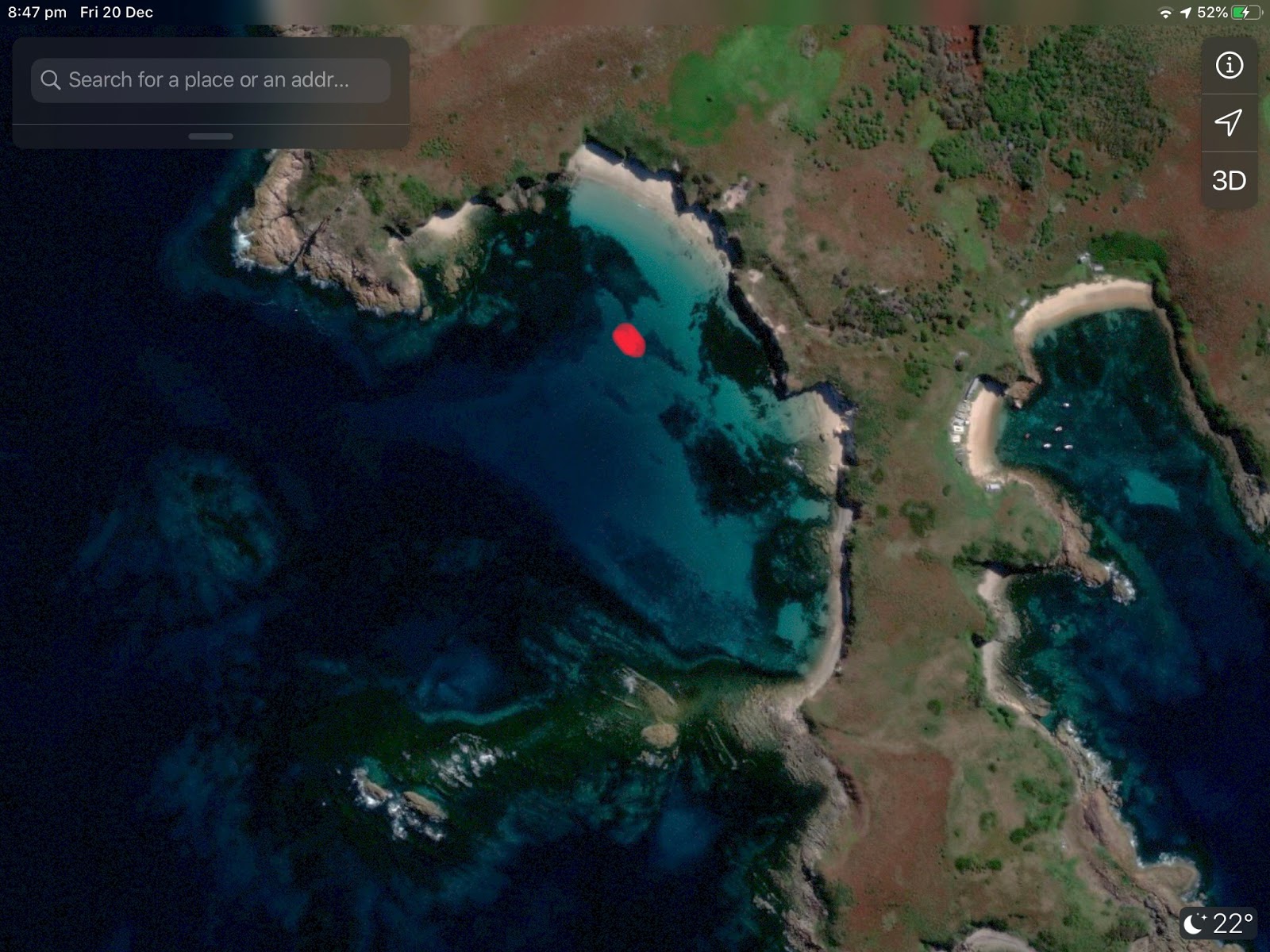
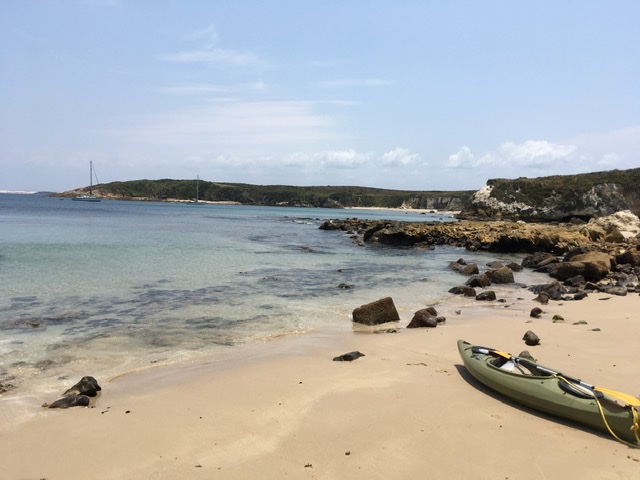
We passed through Shouten Passage, seeing a few more boats anchored in a couple of bays on the north end of Shouten Island, and headed to Bryans Corner and tucked in the to minimise and wind and wave for the blow. We laid out 150ft of chain in the 20-ft depth and pulled hard to ensure the anchor was well and truly set as we read a couple of reports of boats dragging in 30kts. 


Another beach walk this time littered with scallop shells of all sizes and colours. I have heard that scallop diving is supposed to be excellent in Tas and the sight of all these shells has inspired me to look into trying to get a license and retrieve some.


Back on the boat we cracked open a bottle of wine and enjoyed the view. Jude had prepared a wonderful vegetable and chicken curry for supper which certainly hit the spot.


As predicted the wind picked up, 20-25kts gusting to just over 30kts, but we were confident that the anchor was well set so we had a very restful night’s sleep.  


Tasmanian Devil footprint


North Flinders to Wineglass Bay

We checked the weather and it looks like there are lots of weather changes on their way with a couple of large northerly and southerly systems due to pass in the next week. This could mean that we could be stuck here for a while and there are no all weather anchorages. 

We had hoped to stop over in Trousers Bay but we ended up deciding that we had a good window to make it to Wineglass Bay in an overnight passage. Part of this journey requires planning to pass through Banks Strait between Flinders island and Mainland Tasmania. Like many straits Banks has strong currents flowing through it and can cause steep seas in strong winds so good timing and the right conditions are required. 

Our projections showed that we could arrive at the strait at slack water with the 15-20kt wind predicted from the NE and as we passed through the current would build to spit us out the other side. This seemed too good an opportunity to miss soo we decided to go for it although somewhat disappointed that we did not see more of Flinders. 

Our sail down the coast of Flinders and through the strait was absolutely wonderful. Like the day before the winds were 15kts on the beam and the seas were flat in the lee of the island. We were trucking along and very comfortable. We zipped through Bank at 8kts with less than 1m seas. Our price for a wonderful day and evening sail was for the winds to drop below 5 its, as predicted for the rest of the journey to Wineglass Bay through the night so we had to motor, something I am not keen on doing.
It was an uneventful night and the seas were flat so again it was comfortable. Still we have seen no boats or ships but have seen a stationary bright light to the east, presumed to be a drilling rig. The sun came up as we approached Wineglass and lit up the steep and colourful and intimidating cliffs of the Hazard Mountains and entrance to the Bay. 

Finally a fellow sailor! as we entered deeper into Wineglass Bay we spotted a yacht tucked away in the north corner of the bay. As the winds were due to shift to the south in the next few hours we decided to anchor in the southern side of the Bay about 200 mts off the beach. Charts for this bay are not that great so it was hard to see how far we could get into the bay away from the ocean swell but with reports of another boat being washed up on the beach we traded comfort for caution. 

After a brief time chilling, taking in the quite spectacular scenery we decided to head ashore for a walk along the crescent shaped white sand beach, strewn with shells, seaweed and the rotting carcass of a seal. Except for a couple of topless backpackers, according to Jude - she did not tell me until later, there was not a soul on the beach and we strolled to the north end and marvelled at the orange coloured rocks along the far shore. 

Both Jude and I thought the scenery reminded us of our time in the Pacific North West and Alaska so we are so far very impressed with Tasmania!! There is a path at the end of the beach that goes up the mountain to a lookout over the bay. Unfortunately we did not bring our shoes so we could not go up the 1000 steps so we walked back along the beach to the very basic backpacker campsite (wink wink). 

We went back to the boat and picked up out hiking boots and walked back along the beach and up the 1000 step track to the lookout over the bay. When we returned to the dinghy from the walk it was time to go for a swim to cool off. The water looked so tempting. Clear and blue and calm. Surprisingly it was not too cold, probably about 19c As we feared the swell coming in from the ocean made for a slightly unpleasant night sleep with the boat rolling when set broadside to the incoming swell. 

One benefit of the restless night was seeing an amazing phosphoresce show in the water. I have nit seen the like since the Sea of Cortez in Mexico. The water was alive. Small illuminated specks with flashes streaking through the water, some quite large and predator chases prey up and down the food chain. I must have watched for an hour or so and made the uncomfortable night worth it!


Tasmania here we come - Jervis Bay to Flinders Island

A departure weather window appeared for the 21st and it could not have been a better one - 15 knots from the east for 24 hours then turning NE and 20-25 kts. The original plan was to stop over in Bermagui or Eden before proceeding on to Flinders island at the north end of Tasmania but we decided to just sail through on a 2 night 3 day passage. Departure day arrived and winds were light first thing, as expected, so there was no rush to leave. 

Eventually we departed at about 9:30am, still in light winds but forward of the beam so we sheeted the sails in and picked up speed heading east offshore where we caught a bit of the south setting current and headed south and eased the sails for a marvelous beam reach. 

We passed Eden at about 3am the following morning in what was a great part of the passage with seas only about 1.5-2.0m and the following current. We were still about 20 miles offshore as we gradually changed course south west and into the infamous Bass Strait. Here is what Wikipedia mentions: Strong currents between the Antarctic-driven southeast portions of the Indian Ocean and the Tasman Sea's Pacific Ocean waters provide a strait of powerful, wild storm waves. The shipwrecks on the Tasmanian and Victorian coastlines number in the hundreds, although stronger metal ships and modern marine navigation have greatly reduced the danger. Many vessels, some quite large, have disappeared without a trace, or left scant evidence of their passing. Despite myths and legends of piracy, wrecking and alleged supernatural phenomena akin to those of the Bermuda Triangle, such disappearances can be invariably ascribed to treacherous combinations of wind and sea conditions, and the numerous semi-submerged rocks and reefs within the Straits. 

 As we entered the Bass Strait the sun started to rise, the apparent wind dropped slightly but the seas were still kindly. As we sailed further into the strait we picked up a 2.5 knot following current. We dared not believe it. We were ticking along at 9.5 knots and at one time hit 10.5 knots this current also flattened the seas but in the back of my mind I knew the current could not only continue but it would likely turn the other way as we progressed. Sure enough during the following evening and night the current dropped and eventually turned against us, thankfully only by 0.75 to 1.00 knots but the seas changed dramatically. Not only did the seas become steeper the period shortened and we also had two cross seas and a repeating set of 3 large waves that came every ten minutes or so. Then the wind stated to drop along with our apparent wind, which went aft the beam and our boat speed. Now I don’t mind sailing slowly, it’s often very nice to sail slowly at night. On our passage from Noumea we has a couple of days sailing pleasantly along. This however was anything but pleasant with the boat rolling on the seas from different directions which in turn loaded and unloaded the sails. We headed onto the wind to pick up speed and reduce the rolling. This worked slightly but the shifted more NE and we were now heading 40 degrees off course and slowing. We persevered being rolled around on our sleepless watches until dawn came and with it sight of land. Choice: sail slowly on an indirect course too our destination or fire up the engine and be on the anchor by 7 am. Bugger it fire up the engine. 

 As we sailed past outer and inner sister islands the seas flattened and the wind direction became useful so we raised the sails to complete the rest of the passage to Roydon Island on the north west coast of Flinders island. In fact the final sail was magnificent in the lee of Flinders but still with 15knots on the beam. We dropped the anchor in the fairly open bay in only 15 feet of water with weed and sand on the bottom. Not a soul or other boat have we seen on the whole passage or in this anchorage. We were very pleased to not be rolling and bucking and put the kettle on. Although the water was flat the anchorage did not provide much protection from the wind and in fact it seemed to blow harder her that outside. As we arrived early in the morning we had the whole day to relax and plan the next part of our journey and we work our way to Hobart. 

 We came to the west side of Flinders as it looked like an interesting place to visit and had a few appealing anchorages. We had hoped to get to the Kent Group of islands but the wind direction down the strait prevented us from getting there without another night at sea in uncomfortable conditions. From what we have seen so far Flinders and the islands here are quite barren. We have seen a few houses but have not seen any other boats.

Sydney to Jervis Bay

Blurry eyed but well rested we raised our anchor at 4am in darkness and headed out of Sydney harbour and steered Sarita south towards Jervis Bay. The weather forecast was for 20-25 knots from the NE with a strong wind warning in place. We logged on with Marine Rescue for our passage as the choppy seas of the heads subsided. The sun came up in a cloudless sky over the ocean which reminded Jude and I of the many ocean dawns we have witnessed and we became accustomed to the roll of the boat on the ocean swell. 

The winds were around 15knots with the apparent wind well behind the beam so it was initially slow going but we knew the winds would build later in the day along with the seas. Around 10am the winds steadied to around 17-20 knots with periods of 25 knots so we picked up speed but we had to head slightly east to keep the wind from being dead behind us and to make the journey more comfortable but the trade off would be a longer passage as we zigzagged down the coast. Just after midday a huge pod of dolphins started to pass us on both sides. Some sped past and did not linger but others came towards us and performed feats of acrobatics and comedy, rolling on their backs, slapping tails and with groups performing aerial displays. The passing pod lasted over an hour and must have involved thousands of dolphins. Where were they all going or have come from? 

 As the sun was setting low in the early evening sky we made our final gybe directly to the east and the heads of Jervis bay with a towering dark thunder cloud towering over the North part of the bay lighting up the darkening sky with flashes and rolls of thunder. We shortened the sails in anticipation of increased winds from the clouds.
All of the 5 courtesy moorings in the southern part of the bay were taken so we dropped the anchor in about 10m of clear water as the sun set and the winds subsided in the lee of the lushly forested shoreline. It’s always a relief to finish a passage and relax and look forward to what a new destination would have to offer. We called Marine Rescue on the VHF to log off with them at which point they asked us if we had heard about the tsunami warning, which we had not. Did the dolphins know something we had not ? 

Jervis Bay

After a quiet and restful night, no anchor drag or high wind alarms, we brewed the coffee, made breakfast and assessed our surroundings in daylight for the first time and the few boating neighbours. Jervis bay is in fact a very large bay, 9x5 nautical miles, with beaches reported to have the whitest sand in the world. The anchorage we were in is called the Hole in The Wall named after a rock formation on the south west shoreline that resembles a wall that somebody has taken a sledgehammer to. We dropped the dinghy in the water and put the small 2.5 hp outboard on for the journey to the shore over clear waters with part sea grass and part white sand bottom. We went for a swim in the inviting water mindful of the recent shark attack just across the bay a couple of weeks earlier but this could be our last swim of the season as we head into the Southern Ocean. 

The blindingly white beach invited us to stretch our legs so we headed east occasionally stopping for another swim or being pulled into the forest that extends to the shoreline with its impressive gum trees and local fauna. 

 We would be waiting in Jervis Bay for a suitable weather window to head south and at present the 5 day forecast was for strong southerly winds but hey what a place to hang out! Over the next few days we spent our days walking, swimming, sorting and repacking the boat for the least amount of rattles as we rolled down the coast. Of course there were afternoon drinks and naps.

Sunday, January 16, 2022

Time to cast off the dock lines again

It has been 5 years since we moved on land but now it is time to move back aboard and cast off the dock lines and head out on the ocean wave again. Although we have sailed on Sartita reasonably regularly over the past 5 years we have not been on any long passages so it will be interesting to see how we settle back into the routine. Although Jude and I are back on Sarita we are one crew member down as our daughter is staying on land to enjoy her freedom and develop her business. It feels very strange not having her about and both Jude and I miss her very much. Although we hate making sailing plans our intention is to head to Tasmania for the rest of the summer and enjoy what is supposed to be an amazing part of Australia with rugged coastlines, brisk winds, and plenty of activities to keep us busy. We had been watching the weather for a few weeks and strong southerly winds seem to be dominating the weather patterns with only 1 day or so of northerlies before switching to southerlies again. Friday 14th January We spent our first night on anchor at Coaster Retreat in Pittwater before heading down to Quarantine Bay in Sydney Harbour for Friday night, the rationale being that it would shorten our first long passage sufficiently to arrive in Jervis Bay in daylight. The weather forecast for Saturday was for strong NE winds 20-30kts with a southerly change coming into Jervis Bay at around 9pm. Having had a look at the observations (actual winds) over the past few days the forecasts have been overestimated with the higher winds occurring more offshore. We decided that we would take this weather window and if the winds did pick up to 30kts they would be manageable as the would be well aft of the beam. Saturday 04:00 Departed Quarantine Bay in darkness. Forecast was for NE 20kts but we had 6kts for the first hour but then the winds built to NE 15kts as we moved offshore. The seas built to around 2-2.5 over the rest of the day as the winds built up to around a max of 25kts. A massive pod of Dolphins passed us around lunchtime, probably numbering in the thousands as the passed us for over an hour. They demonstrated their usual playfulness and acrobatics. We entered Jervis Bay just as the sun was setting and with a towering thunder cloud over the northern part of the bay looking and sounding rather ominous. We dropped an anchor in the southern part of the bay, still in northerly winds but on cue the winds turned to the south around 10pm.
Overall it was a great first passage. A bit lumpy but we have experienced far worse. The passage length was longer than planned as we headed more on the wind and offshore to have a more comfortable sail.

Saturday, December 28, 2019

A cruise at Christmas

Merry Christmas from Broughton Island

It has been a long time coming but we finally managed to find the time to take Sarita on a short cruise up the coast and escape the Christmas madness on the water near Sydney. 

We chose to head to Broughton island, which is a few miles off the coast near Port Stephens, as it had a reputation for being not only beautiful but also quiet with a couple of excellent anchorages in both northerly and southerly winds and we were not to be disappointed. 


We loaded Sarita with provisions on Saturday afternoon and slept onboard at the dock so we could make a dawn get away for the 80nm passage north hoping that the southerly winds forecast would eventuate.

We were up at 5am, checked the forecast- 20-25kts reaching 30kts in the afternoon with 2-3m seas- so it looked like we were in for a nice sail with the wind behind us.


As we left the dock the winds were already 15kts, gusting to 20kts so we unfurled the sails a few minutes after leaving. We had a gentle sail for the first 45 mins as we ran down Pittwater knowing that it would get a bit rougher as we went out to the open ocean. As we past Barrenjoey light house on our starboard the seas built as the wind against the tide made the seas steeper but they settled down as we got about 1/2 mile offshore and pointed north.

The conditions were pretty much as predicted with the winds at about 140 -150 degrees apparent, 20-25kts, with occasional builds to 30kts so we made good speed despite the adverse current of about 1 knot. We had the Genoa fully out and the main with 1 reef, sheeted in to reduce the rolling in the 2.5 mtr seas and not to blanket the headsail. Having been sailing in the protected waters of Pittwater and Broken bay it took a couple of hours to settle into the beautiful rhythm of the ocean.

We decided to spend our first night in Shoal Bay, in a Port Stephens, as it was a familiar anchorage to if we arrived after dark, but we had made good time and rounded Tomaree Head just before 7pm and dropped the trusty 33kg Rocna a few minutes later in a pretty much empty anchorage except for three catamarans. Jude made some supper while Katya and her friend Tabatha arose from their slumber and started a new art project.

The following day the winds were forecast to remain southerly at about 20kts with showers so we decided to stay and relax on the boat and have a look around Shoal Bay. We took the dinghy to the beach and the girls disappeared off in search of op shops while Jude and I took a stroll along the waterfront and had a coffee. We met up later in the Country Club (read up market Pub) where we had an early supper before heading back to the boat.

We did not have an early start the next day as we only had to sail about 9 miles to Broughton Island and departed Shoal Bay at around 9.30 am. The wind was again against the tide/current exiting Port Stephens so the seas were quite lumpy for a while but they soon settled down as we turned north once again with Broughton Island already insight. The winds were now north easterly so we were close hauled in pretty flat seas and sunshine and arrived to Coal Shaft Bay before 11am.


 We dropped the anchor in the beautiful bay with clear waters in about 10mts over hard sand. To our immense relief and surprise there was only one other boat in the bay. No doubt they must have wished we had not turned up and spoilt their seclusion.


Kintail. built in 1947
The Island is part of Myall Lakes National Park and uninhabited except for a few small fishing huts in Esmeralda Cove and a small camp site with only 5 sites. The island is an active seabird colony and reminded us a lot of Isla Isabella in Mexico although the anchorage here is better.

While Jude was trying to catch up on a long overdue crochet project (20 yrs) I took the dinghy ashore to see if I could walk over to the other side of the island. To get off the beach I had to clamber up a short cliff and once up at the top you can see the other side of the island.

We all enjoyed relaxing away from the hustle and bustle of Sydney, reading, swimming, kayaking and beach combing and I believe this is our 6th Christmas onboard Sarita, the first being in Victoria, Vancouver island in 2011.


Geode found on the beach 

More geodes 

We departed the island just before dawn on the 27th December with forecast winds of 10-15 kts from the NE building to 15-20kts in the afternoon. We motored for the first 3 hours until the wind built enough for a down wind sail. We decided to try out our new gennaker which worked superbly giving us 6-7 knots in 10-12 knots apparent albeit with just under a knot of southerly current helping us along. The seas were only about 1m or under so it was a very pleasant sail.

As we approached Broken bay we decided to furl the gennaker (Facnor FX continuous line) so I went forward while Jude blanketed the sail with the main and eased the sheet. All went well until the shackle holding the furler to the bowsprit gave way (not sure why) and then all hell let loose. With the sail not attached at is base the furler shot into the air very quickly. I still had hold of the furling line which zipped through my hands before I knew what was happening and the furling line caught around my leg lifting me into the air as the sail started to rapidly unfurl again. Luckily I managed to hold on with one hand and free my leg with the other before I was lifted overboard. Now we had a wild and uncontrollable sail flailing about with a heavy furler on the lower end and the sheets snaking about on deck one of which caught around Jude’s leg which she managed to free before she to went overboard. This is a reminder of how things can go pear shaped pretty quickly. Both of us could have easily been overboard with the boat heading south. Jude has a massive bruise on her leg from where the rope wrapped around it and I have some nasty rope burns on my hands. It took us about 5 mins to get the unfurled sail back onboard and into the sail locker. Now to work out why the furler shackle gave way and refine our furling procedure.

Friday, February 24, 2017

Back-track. Noumea and the passage to Australia

We departed Tanna in Vanuatu in the early afternoon in a fresh breeze, beating our way out back towards Fiji so that we could get a good sailing angle to pass the southern tip of Tanna in a south-easterly wind. We watched the volcano spewing out its regular plumes of ash as Tanna sank into the horizon in the early evening light. 
Route from Tanna, Vanuatu to Noumea, New Caledonia

The winds lightened to around 10 knots or less and I had to head off course, on to the wind, to keep some apparent wind in the sails to stop them flogging. I would have put up the asymmetrical spinnaker but our hydraulic backstay tensioner has been playing up and the back stay is not as tight as I would like it. 

We sailed slowly, and comfortably through the night and then a rather unnerving and familiar alarm sounded: the autopilot had malfunctioned. After having had a closer look the bolts holding the hydraulic ram to the bulkhead had sheared. Of course this happens at night! Jude took the helm with memories of our 18 days of hand-steering coming back. Worst case scenario would be 24 hrs of hand steering this time. 

I replaced the bolts on the bracket but the hydraulic ram mounting bush had been damaged when the bolts sheared. Having learned my lesson last time I had purchased a spare ram so I mounted the new one ( I love it when I have a spare when things go wrong) and after about 1 hour we were back using the autopilot. 

We sailed through the night and arrived at the pass through the reef at the south eastern tip of New Caledonia at dawn, as planned, to get the 4 knot flood tide into the worlds largest lagoon. We sailed at 9 knots through the pass with a light wind on our beam and weaved our way through the smaller islands and reefs to Noumea at a slow but leisurely pace.  

Jude had been bitten by a mosquito on Tanna which had subsequently become infected and swollen and her leg was looking rather nasty ( I won't go into what it looked like) so a visit to the hospital in Noumea would be top of the list for things to do.

Having tied up to the dock in Noumea we all went for a walk around town given that it was too late in the afternoon to check in to immigration and customs. Noumea was surprisingly modern and quite similar to many cities in France, not surprising as it is actually part of France. Having been deprived of a decent supermarket for quite sometime we were delighted to look at the well stocked shelves of the nearest Carrefor and bought some French bread and croissants and French cheese enjoying the sounds of local bands playing in the nearby restaurants and bars.

The following morning we went to check into immigration which was totally painless and then we went to the accident and emergency at the hospital to get Jude's leg examined. The verdict was inconclusive and Jude was prescribed a course of antibiotics and asked to come back in a week for a further examination. The hospital was great, not that new but they were building a new one down the road but very efficient, helpful and friendly in a French way.

The next week was spent preparing Sarita for our entry into Australia, a notoriously rigorous examination by customs with many restrictions on what we could bring into the country. We opened every locker, storage space and cleaned it and through out any items that might cause a problem. We wanted the boat spick and span for our entry. I repaired the hydraulic backstay, albeit temporarily as the seals have worn and will need to be replaced in Australia and I had the old autopilot hydraulic ram mounts replaced, actually having to have new bushes made. Jude's leg did not improve so we went back to the hospital and they performed an X-ray after a specialist had a look at it. Again we were told to continue the antibiotics and com back in another week. 

We were already behind schedule and we were now officially in hurricane season with a 5-7 day passage ahead of us, not my preference but we had no option to stay.

We were pleasantly surprised by New Caledonia and what it has to offer the sailor. It has some great anchorages, albeit somewhat exposed to the winds but sheltered by reefs. The diving was supposed to be excellent. 

Our friends, Neil and a Jessie had arrived in Noumea a few hours after us and we spent a few days together diving including a wreck dive in the pristine waters. This would probably be our last chance to dive for quite sometime. 
Neil (Red Thread) below on the wreck dive

An abundance of turtles in New Caledonia

We visited the Amendee lighthouse again anchoring in crystal clear waters and surveyed the vista from the top of one of the oldest lighthouses in the Southern Hemisphere.

A view up the stairs of the lighthouse


We had been keeping an eye on the weather, trying to see local patterns emerging. Ideally we would depart Noumea on the back of a high pressure system peeling off the coast of Australia and our plan was to make a landfall as far south as possible, Sydney if at all possible or Coffs Harbour. 

Jude went back to the hospital for another check up and although the sore had not developed further it still looked pretty angry. The doctor advised us to double the dose of antibiotics and told me how to operate, or cut out the infection, if it got any worse on the passage to Australia, something a Jude was understandably not too keen on. 

We identified a potential weather window with a high pressure system giving us the winds we needed but there was a rather nasty low pressure system predicated to develop on the equator sometime after the high pressure system developed. I had been watching the weather patterns in this region for a few months and this was the first low pressure system predicted in that time and it could be a potential cyclone. We would have to watch it carefully.

We did our final provisioning which was not that extensive given we cannot bring much into Australia and left the marina in Noumea and anchored in Ilot Maitre planning an early morning departure in a couple of days.

Dolphin wanting his tummy tickled
We departed the anchorage in light winds, drifting slowly under head sail alone headed for the pass into the open ocean. As we exited the lagoon the ocean swell built up and eventually the winds did as well but coming closer to our bow setting us on a close hauled south east course pounding into the waves making a fast pace of 8.5 knots but unfortunately having a 1-1.5 knot current against us. 

Approx route to Coffs Harbour

 We had engaged the services of a weather router who had advised us to head almost directly west until picking up the east Australian current which heads at a rate of up to three knots down the coast. I decided to ignore his advice for two reasons: firstly I hate going off the rhumb line to a destination but secondly I was nervous of this potential developing low to our north and wanted to get as much southing in as possible before it started its track south. 

One last ice cream
We made good speed through the water over the fist couple of days albeit into wind but the current was set against us. Our friends on Red Thread had left after us and had decided to take the less direct route and managed to pick up a good current so although their course was longer they we gaining ground.

We checked into the shortwave radio net and gave our position to the controllers in New Zealand with them replying that they thought we were "brave" leaving a Noumea with the predicted low developing. This made me a bit nervous and we double checked the weather forecasts. One of the predictions was for the low to develop quickly and head south and then west on a direct course to Australia just north of our route, which made me even more nervous. Since leaving Mexico we have sailed pretty much all the time in mostly reliable trade winds and now as we head south we enter the less predictable and somewhat stronger wind patterns that peel off the coast of Australia.
The winds started to lighten as predicted and we ended up raising the spinnaker which we kept up for three days straight mostly doing only only 3 knots but very comfortably, Jude even cooked up a full roast chicken dinner which we ate at the table in the cockpit as flat as if we were in a marina. We were nearing the coast of Australia and wanted to get there as soon as possible but did not want to turn the engine on if we had to. We decided that given the weather predictions we could not make it all the way to Sydney as the predicted low was going to swing to the east of us and then north blocking our route with 30 knot winds from the south and 3-4m seas so we headed for Coffs Harbour.
38 hrs of spinnaker sailing. Slow but very comfortable
Neil and Jessie on Red Thread had meanwhile overtaken us on their longer route but positive current. I should have followed the routers advice! 

We ended up sailing into Coffs Harbour having only motored 2.5 hrs from pulling up the anchor but it could have been quicker. Now to run the gauntlet of Australian customs and border services. 

The Australian customs and Border services don't have a great reputation with overseas sailors, with stories of over officious, rude, strict and expensive processes so we were somewhat nervous of our arrival.
Ariel view of Coffs Harbour

We hailed the authorities on the VHF and were advised to drop anchor and wait in the outer Harbour as the inner Harbour was still being repaired from a violent storm earlier in the year. The outer Harbour was subject to an uncomfortable swell coming from the east so we did not plan to stay long after clearing customs.

We waited to be summoned and after a couple of hours were directed to tie up to the customs dock and "prepare to be boarded" after we tied up to the dock a Jude leapt onto the dock and gave one of the officials a hug as she was so excited about being back in Australia. I don't think he quite knew what to do.  Three officials boarded the boat and gave it a reasonably thorough look over but we pleasant and efficient. They confiscated a few items, mostly food and stamped our passports. We had officially arrived and were relieved to pass the process. It was relatively painless and they charged us A$340 for the privilege (in fact they charged me twice and it took me 2 months to get the overcharge back) but it was OK in the end. We have heard that other boats were treated very rudely in Brisbane and Bundaberg but it's all hearsay.

We spent a bit of a rolly night with 20 knot winds on anchor in the outer Harbour and departed early in the morning for Port Macquarie where we would meet Mike, Irit and Daniel, Jude's family, Daniel would be sailing down to a Sydney with us. It was on,y. A short 70 mile trip down but we had to cross the notorious narrow river bar at slack water. We spoke to the marina office who gave us some advice as to how to cross the bar and told us that there was a web cam to make sure that there were not too high standing waves. The crossing went without a problem although our depth gauge did read 0 feet as we crossed which made me hold our breath for a few seconds. We slowly motored a short way down the river to the Marina where the very friendly manager met us and helped us into the slip.

Arriving in a medium sized Australian town after being so long in remote areas was a bit of a shock. One of the first things we had to do was go to the supermarket and get some food. Walking down the isles seeing the huge selection of food and other goods after having a minimal selection for so long made us question the fairness.

Mike, Irit and Daniel arrived laden with champagne and other goodies and we enjoyed celebrating our arrival in Australia and completion of our Pacific crossing with them, feeling elated and relieved. 

We spent a couple of nights in the Marina, walked around the typically provincial Australian town and had a few drinks with a Neil and Jessie who were soaking up Australia even seeing some kangaroos and Koalas with the local butcher who was generous enough to show them. 

Mike and a Irit departed and we left the marina early in the morning with Daniel bound for Port Stephens, about 100NM. The bar crossing was OK and we headed a few miles offshore to try and pick up the southerly current, not that we caught much of it. 

The winds picked up as we approached the entrance to Port Stephens which is about 0.5 mile wide. With the wind from the NE we jibed and shot into the protected port under darkness, a bit nerve wracking as there were no lights marking either of the headlands and there was a bit of traffic coming out. 

We decided to anchor on the northern side as the forecast showed strengthening NE winds and we wanted a good nights sleep. Sure enough as we approached an anchoring spot the winds and seas died down and we dropped the  anchor in just 15 feet of water and enjoyed a good night of sleep until dawn when the wind picked up from the south and along with it the swell. We raised the anchor, and the sails, and had a short sail across the bay to Shoal Bay where we went ashore and walked along the beach and had a fish and chip lunch, quite a luxury for us. We had our first swim in Australian waters and I have to say it felt quite "bracing", bloody cold in fact. I had forgotten how much colder the Australian water is compared to the tropics.

Our next passage would take us from Port Stephens down to Pittwater which will be our home for the foreseeable future. If we left at dawn the 70 mile passage should still enable us to arrive before darkness. So before the sun peeped its head over the horizon we wee on our way in light winds. There were two other boats heading out at the same time. We motored out of the large Harbour raised the sails and made a slow heading south east to try and pick up some of the southerly current. 

We continued heading offshore for a few hours before heading south towards our destination. The seas were pretty comfortable and the sun was shining so it was quite pleasant.

We entered into Pittwater around 3pm and headed towards a mooring field known as "The Basin" is an area set inside the national park and has probably over a hundred moorings, mostly club owned but some public. We picked one up and enjoyed being back home, a really strange feeling I must say.