We raised the anchor in La Cruz at around noon on the 14th
March having waited for the afternoon thermal to build in the bay that would
give us some wind to get to the ocean winds. We had a combination of feelings:
sadness at leaving friends and Mexico behind us, nervousness about our first
long distance Ocean passage and excitement about the new experiences ahead but
it was good to be on our way after many months of preparations.
The passage is almost exactly 2700 nautical miles from La
Cruz to Hiva Oa in the Marquesas and if we are lucky we might get close to that
number but it all depends on where the winds are and how much tacking and
jybing we have to do along the way which will lengthen our trip. I had engaged
the services of Bob McDavitt, a New Zealand Weather router, who would provide
his thoughts on the best route to the islands to maximize the winds and to
provide a backup if any nasty weather arose which we might not pick up on. Having studied the route and the weather
patterns along the way I had mentally split the trip into 4 sections: The first
section was to get offshore through the light wind areas that are effected by
the Pacific High pressure systems and to the NE trade winds that blow
constantly nearer the equator. The second section is to sail through the NE
trade winds to a point SW of our departure point at which we will cross the
lighter wind section of the ITCZ (Inter Tropical Convergence one). The third
section is crossing the lighter winds of the ITCZ to another chosen point where
one hopes to pick up the SE trade winds that run south of the equator then the
final section being the SE trade wind run to our destination. Sounds simple but
there is a lot of guesswork and hope that the route that has been chosen has
enough wind but not too much wind. Each section has its own idiosyncrasies.
Section 1. to The NE Trades.
The weather for this section of the journey is dominated by
the effects of the Pacific High pressure system which at this time of the year
is trying to establish itself, develop and generally move northwards. The
Pacific high dominates the weather pattern for pretty much the whole of the
west coast of the United states and northern Mexico in the spring and summer and
once established provides north to north east winds. The theory goes that when
the Pac High establishes you take the N/NE winds and use them to drive you
south west to reach the NE trade winds that run along the northern equator but
there are a couple of things to think about and the main item being the effect
of land and the systems which develop over it often sucking any wind out of the
Pac High and then there is the guessing if the high has actually established or
is it just a temporary build up of high pressure. Some people like to wait
until late March / early April before they depart ensuring a higher chance of
getting winds whilst others leave earlier taking a chance with the desire to
have more time in the Marquesas Islands and beyond. We fall into the later
camp.
We studied the weather files on ZYGRIB and it looked like
there was a weather window developing for Monday the 14th March. It
was less than ideal with an area of low winds showing up after a few days that
might mean we would be wallowing about for days but we decided to take a chance
as there would be no guarantee that a week later or even two weeks later it
would be any better.
We said our goodbyes to all our friends in La Cruz, most of
whom we would not see again and some we would be meeting up in a few weeks. We
vacated the slip that we had been in for some 3 months and moved out to the
anchorage so that we could get some acclimatization to the movement of the boat
and do the last minute preparations before heading offshore. I studied the
weather one last time and made the decision that we would be leaving tomorrow.
All our provisions were safely stowed and other items tied
down so as not to be thrown about by the movement of the boat on the crossing.
We raised the dinghy on to the foredeck and lashed it down and double secured
the kayaks, which are on the cabin tops.
D-Day had arrived and we waited for the thermal build-up of
winds in Banderas bay to occur which would enable us to get out of this
beautiful bay and like clockwork it occurred at midday. Alison and the boys
from Kanta Anae rowed out to us to say goodbye which was a lovely gesture and
much appreciated. We raised the anchor, set the sails and headed down the bay.
After about 4 miles the winds developed nicely on the beam and we set a course
for our first waypoint. We were doing 6.5 knots and we all had smiles on our
faces.
We sailed into our first night with a quarter waxing moon, calm
seas and Jude and I started our 3 hrs on 3hr off watch. By dawn we had covered
157 miles the winds were lighter and we had 13 squid on deck and 10 flying
fish.
By mile 345 we were in the light wind zone predicted by the
Grib files and we were pretty much stationary. We waited to see if the winds
picked up but they did not. An amazing sunset wowed us all.
The winds were still light to non-existent in the morning so
we decided to use some of our fuel quota. Before we left I decided to allocate
an amount of fuel to each section of the journey so that we don’t use too much
on this journey. For each leg we allocated 25 hrs and we would have approx 15
hrs in reserve.
For the next couple of days the winds were 7-10 knots from
the north to north west keeping our apparent wind forward of the beam and speed
6knots plus. Boobies, of the bird variety, tried to land on our mast and a
couple successfully hitched a ride with us on our solar panels.
By the 19th March, 5 days after leaving La Cruz I
believe we found the NE trade winds. We had covered about 700 miles 140 of
which were under motor, pretty much as predicted.
Section 2
NE Trade wind section
The winds and seas were steady from the North to North east 12-15
Knots but the seas were confused, no nice rolling ocean swell at 15 seconds.
This made the sailing a little frustrating as aiming to sail downwind (SW) the
sails flogged with the wind angle greater than 150 degrees so we decided to
head a little west to keep wind in the sails and stop the annoying flogging of the
main and head sail. We tried just a poled out Genoa but still the sail flogged.
By sailing more west we would add more miles to the journey.
 Over the next couple of days the winds built and so did the
seas. A steady 20 knots, 25 knots and 10-15 foot confused seas made for quite
an uncomfortable ride. We reefed the sails to add a bit of control. As we
approached the evening of the 21st we saw a large dark gray cloud
ahead of us. We prepared for rain. As we entered the cloud it was like entering
a different world, the visibility diminished, the winds increased and the seas
became larger and more turbulent. We reduced sail again. We waited to exit the
cloud but for the next three days we were locked in this alternate world. You know
when you are at the top of a tall building people tell you not to look down,
well people should say to sailors in rough weather don’t look behind you in following
seas. When looking back in these conditions I compared it to looking to the top
of a mogul hill. How could it seem up-hill? The water was white with streaks
cascading down, seas came from behind and on our quarter, waves seemingly
trying to reach into the cockpit like desperate white hands. Several times we
had waves board the boat and water came into the cockpit. We had the weather
boards in the companion way so as to prevent water going into the cabin. We
surfed down the waves and at one point reaching a new all-time record for
Sarita of 12.6 knots. (last record was 10.6 knots heading under the Bay bridge into
San Francisco in 2011) Sometimes the angle was such that we slid sideways down
the wave and at the bottom we hit waves and water covered our aft deck. Through
all this the rain came down and the light was poor. Quite “exciting”. I have to
award Jude a medal for her actions during these few days as she went on as
usual and at one point as we were side-sliding down one of these steep 20 foot
waves I looked down below and saw here making a vegetable soup from scratch,
frying vegetables. Quite remarkable. Through all this Amber and Katya chatted
away, watched movies and listened to music, almost oblivious to what was going
on around us.
Over the next couple of days the winds built and so did the
seas. A steady 20 knots, 25 knots and 10-15 foot confused seas made for quite
an uncomfortable ride. We reefed the sails to add a bit of control. As we
approached the evening of the 21st we saw a large dark gray cloud
ahead of us. We prepared for rain. As we entered the cloud it was like entering
a different world, the visibility diminished, the winds increased and the seas
became larger and more turbulent. We reduced sail again. We waited to exit the
cloud but for the next three days we were locked in this alternate world. You know
when you are at the top of a tall building people tell you not to look down,
well people should say to sailors in rough weather don’t look behind you in following
seas. When looking back in these conditions I compared it to looking to the top
of a mogul hill. How could it seem up-hill? The water was white with streaks
cascading down, seas came from behind and on our quarter, waves seemingly
trying to reach into the cockpit like desperate white hands. Several times we
had waves board the boat and water came into the cockpit. We had the weather
boards in the companion way so as to prevent water going into the cabin. We
surfed down the waves and at one point reaching a new all-time record for
Sarita of 12.6 knots. (last record was 10.6 knots heading under the Bay bridge into
San Francisco in 2011) Sometimes the angle was such that we slid sideways down
the wave and at the bottom we hit waves and water covered our aft deck. Through
all this the rain came down and the light was poor. Quite “exciting”. I have to
award Jude a medal for her actions during these few days as she went on as
usual and at one point as we were side-sliding down one of these steep 20 foot
waves I looked down below and saw here making a vegetable soup from scratch,
frying vegetables. Quite remarkable. Through all this Amber and Katya chatted
away, watched movies and listened to music, almost oblivious to what was going
on around us.
We eventually came out of this other world on the evening of
the 23rd. The winds lightened to 14 knots and we saw blue skies. We
sighed with relief and so did Geeves, our autopilot who stopped working as if
saying I have had enough. Jude and I looked at each other as I took over the
steering thinking that we were under half way and the prospect of hand steering
24hrs a day in weather like we just had was not a great thought but we had no
choice, going back was not an option. We tried to continue our three hour
watches but Jude found that 3 hrs was too hard, and so did I, so we reduced the
watches to 1 hr on 1 hr off. Geeves!
Geeves! Come back please we will not be so hard on you.
In my off watch time I tried to fix the head unit of the
autopilot but it seems that water managed to enter the unit and create a short.
I emailed friends back in La Cruz to see if they could find a work around from
the manufacturer and order a replacement for our arrival in the Marquesas. It’s
great to have some wonderful people trying to help.
We continued on, exhausted particularly on the night
watches, sometimes it was almost impossible to wake up after only an hour of
sleep to resume duties but on we had to go. In the end we decided to heave to
(stop sailing) and get 4 hours of sleep before resuming. The prospect of
continuing this for another 3 weeks was not something I wanted to think about.
We hoped that we would not have to go through another gale at night as this
would be very hard to manage. In our off
watches, only an hour at a time, we continued our other duties, Jude keeping us
fed and watered, me downloading weather, keeping the batteries charged and
making water.
By the evening of the 26th I believe we had
reached the northern limit of the next section, crossing the ITCZ and it was time
to head more south having been heading more west up until this point.
Section 3 – Crossing the ITCZ to reach the SE Trade winds.
This section was one I was not particularly looking forward
to as predictions were for light to variable winds, making for slower progress
when we really wanted to get to our destination, and this area is known for its
squalls which bring heavy rain and high winds. Great! Just what we need, a
greater challenge.
 On the afternoon of the 27th we hit our first
squall. We saw it on the horizon, turned the radar on and saw it was about 5 miles
wide and about 20 miles long. We tried to wait and go around it but it soon
engulfed us. Winds built to 35knots, rain lashed down and the seas built
becoming streaked with white water. I put my foul weather gear on and, the rest
of the crew went below and we put all the weather boards in the companion way
to prevent water entering the cabin. We ran as much across the waves trying to
escape the system, we had a shred of head sail out but were still making 7
knots. It was quite exciting and if I was not concerned that this might last
through the night and another day I would have enjoyed it but being exhausted
the prospect of hand steering for 12hrs straight was daunting to say the least.
Thankfully our first major squall lasted about one hour before we popped out
into the dwindling light of dusk, the winds lightened and the seas almost
immediately calmed. We continued sailing until 4am when we hove-to for 4 hours
to catch up on sleep.
On the afternoon of the 27th we hit our first
squall. We saw it on the horizon, turned the radar on and saw it was about 5 miles
wide and about 20 miles long. We tried to wait and go around it but it soon
engulfed us. Winds built to 35knots, rain lashed down and the seas built
becoming streaked with white water. I put my foul weather gear on and, the rest
of the crew went below and we put all the weather boards in the companion way
to prevent water entering the cabin. We ran as much across the waves trying to
escape the system, we had a shred of head sail out but were still making 7
knots. It was quite exciting and if I was not concerned that this might last
through the night and another day I would have enjoyed it but being exhausted
the prospect of hand steering for 12hrs straight was daunting to say the least.
Thankfully our first major squall lasted about one hour before we popped out
into the dwindling light of dusk, the winds lightened and the seas almost
immediately calmed. We continued sailing until 4am when we hove-to for 4 hours
to catch up on sleep.
The following day the winds lightened for the first time in
quite a while, a sure sign we were in the ITCZ. I downloaded the weather files
and they did not look encouraging, light winds all the way to the Marquesas.
Could our passage extend to over thirty days? Possibly especially if we
heave-to every night to catch up on sleep.
I decided that as we were pretty sure we were in the ITCZ or
the doldrums we could start using our next quota of fuel so when the winds were
below 4 knots we motored to find wind. Most of the time we found some wind in
an hour or two and started sailing again. We encountered a few more squalls
which we picked up on the radar and were more confident of our abilities for
each new one we encountered but still we hoped not to encounter on in the dead
of night.
On the 31st March we crossed the equator a major
physical and mental milestone for us. The mental one being the more important
as this signaled an approach to the final leg of the trade winds. We toasted Neptune
with a bottle of bubbly, the girls dressed up in home made masks and made me a
crown. It was a beautiful day, with light winds but we were making good speed
in calm seas. Over the next couple of days we drifted, sailed and did a bit of
motoring.
Section 4 – The SE Trades to our destination.
The weather files still looked depressing – light winds of
less than 10 knots aft the beam all the way to the Marquesas for the foreseeable
future but by the evening of the 1st April the SE winds started to
build and with them a current of up to 2 knots with us! With the wind on our
beam we started to make good progress although at times the seas were very
confused with a large cross swell knocking us sideways every few minutes.
During the day these were OK as we could see them coming but at night they
surprised us. At the start of our hand steering we found night sailing
particularly difficult, how to keep a course. Sound easy right, focus ahead,
follow a star or a cloud but when the skies are black and nothing can be seen,
Jude and I found that our brains told us we were spinning in circles. Add sloppy,
rolling seas to this and it made it really frustrating and exhausting. It took
a while to master a technique but we ended up pretty much using the compass and
checking our heading every few minutes. If there were stars to follow then
great but quite often they vanished behind clouds and we were back to the
compass. Getting comfortable when hand steering was also hard, we each had our
own positions and methods to make our watch more comfortable.
Slowly the seas became more stable and the winds more steady
but still we had squalls with heavy rain and winds up to 30knots but we could
see these coming on the radar and we prepared for their arrival.
As the winds lightened and the seas became more stable Amber
was able to help us on more of the watches and what a godsend that was.
Suddenly we had two hours off several times a day and eventually Amber shared a
couple of night watches.
 Different milestones were important to the moral of
everybody, we wanted this trip over. Every 100 miles was celebrated and when
the Distance to destination fell below 1,000 miles then 500 miles our spirits
lifted.
Different milestones were important to the moral of
everybody, we wanted this trip over. Every 100 miles was celebrated and when
the Distance to destination fell below 1,000 miles then 500 miles our spirits
lifted.
On the evening of the 6th April, as the sun set we
finally spotted land away in the distance, not our destination but of Hiva Oa
but it still signaled that the end of this leg of the journey was in sight. We
decided that we would all sail through the night and not heave to and sleep, we
knew we would be exhausted on arrival but we would be able to sleep. As
darkness fell the chartplotter teasingly showed us that we would be arriving in
14 hours time, that was just 4 watches each, but as darkness fell so did the
winds and our speed, the time to our arrival extending as the small hours of
the night approached. 14 hrs hung there through the night. With dawn came the
sight of our destination Fatu Hiva, the most majestic and welcoming sight I
have ever seen. We knew we could rest, stand upright, have a cold beer, gin and
tonic eat normally and step on land.
At just after 12pm La Cruz time, 7:30am local time we
dropped the anchor on Fatu Hiva having circled the anchorage to find a suitable
spot that was not too deep. We celebrated, laughed, hugged each other and
congratulated each other on reaching our destination. 3014 nautical miles in 24
days.
If I had been told before we had departed that we would have
to hand steer the boat over 1700 miles in challenging conditions, there would
have been no hesitation in deciding not to leave but now I am almost glad we
did it. We have all learnt so much, not only sailing but what we can take. Not
once did our tempers fray, yes we had many moments or exhaustion and despair at
the task ahead but we remained positive and got on with the job. I can now
berate myself for not having a spare autopilot system. Its not that I did not
think about buying one, I have done so many times over the past few years but I
could not bring myself to pay the $5,000 plus for a complete new system. Now of
course I would have gladly paid that price plus more, and I probably will have to
as the cost of getting a new system out to one of the remotest islands in the
world does not come cheaply. Lesson learned.
Now we can enjoy this wonderful paradise which from first
sight is beyond comprehension and explanation but that will come later for now
I will be drink, be merry and SLEEP, oh will I sleep!
In summary.
The planned route was for 2710 nautical miles but we ended
up doing 3014 nautical miles. Some of this extra mileage is due to a change of
plan and wanting to head more west before crossing the ITCZ as it appeared to
be narrower but also wanting to stay in the NE trades longer rather than the
variable winds and squall zone just north of the equator. We also decided not
to sail directly downwind as the sails flogged badly in the high seas so we had
to jybe our way down the course line. I believe that some of the extra distance
should be attributed to our hand steering as we found it almost impossible to
stay within 5 degrees of the course so we made a continuous “S” course along
the route, perhaps adding 10-15% of distance. Our overall time was extended
mainly due to our heaving-to each night to get some sleep but also to our
action of having reduced sail most of the way after Geeves failed so as to
reduce the effort to steer the boat.
I think the weather and seas conditions were a little different
than expected. The NE trades were not the nice downwind sleigh ride we had been
led to believe but the seas were confused and uncomfortable. The ITCZ section
was pretty much as predicted and if anything much fewer light winds but we must
have been lucky. The SE trade wind section was so much better than the NE trade
wind section, although there were some contrary seas at the beginning the winds
were more steady, as predicted 15knots and more on the beam than aft the beam
making for a more comfortable direct sail.


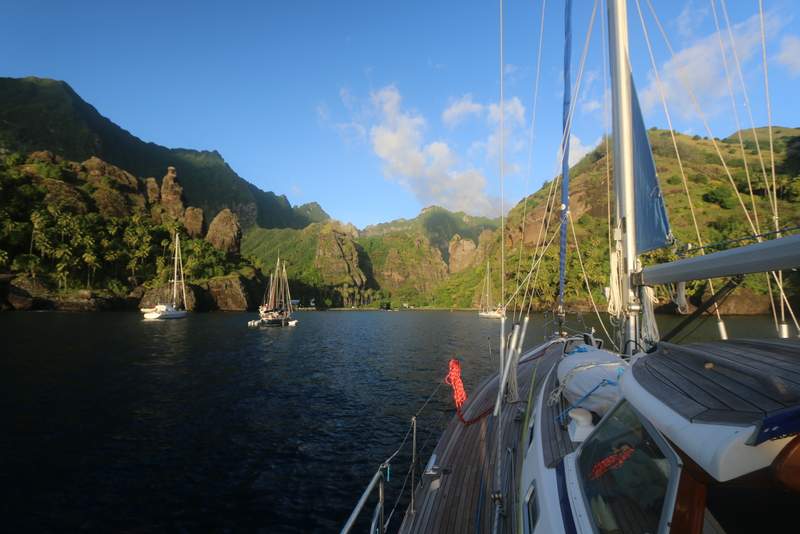
 Now that we could relax we took in the breathtaking beauty
of this place which more than lives up to its reputation as being one of the
premier cruising destinations in the world. I had seen many a sailing magazine
with pictures of Fatu Hiva tantalizing readers to far flung destinations and
now we were here, a dream realized. We
sat in the cockpit and for the first time in nearly a month our muscles relaxed.
No longer did we have to act against the rolling motion of the boat. No longer
did we have to cling on to a hand hold to move about the boat and tonight we
can sleep.
Now that we could relax we took in the breathtaking beauty
of this place which more than lives up to its reputation as being one of the
premier cruising destinations in the world. I had seen many a sailing magazine
with pictures of Fatu Hiva tantalizing readers to far flung destinations and
now we were here, a dream realized. We
sat in the cockpit and for the first time in nearly a month our muscles relaxed.
No longer did we have to act against the rolling motion of the boat. No longer
did we have to cling on to a hand hold to move about the boat and tonight we
can sleep.